
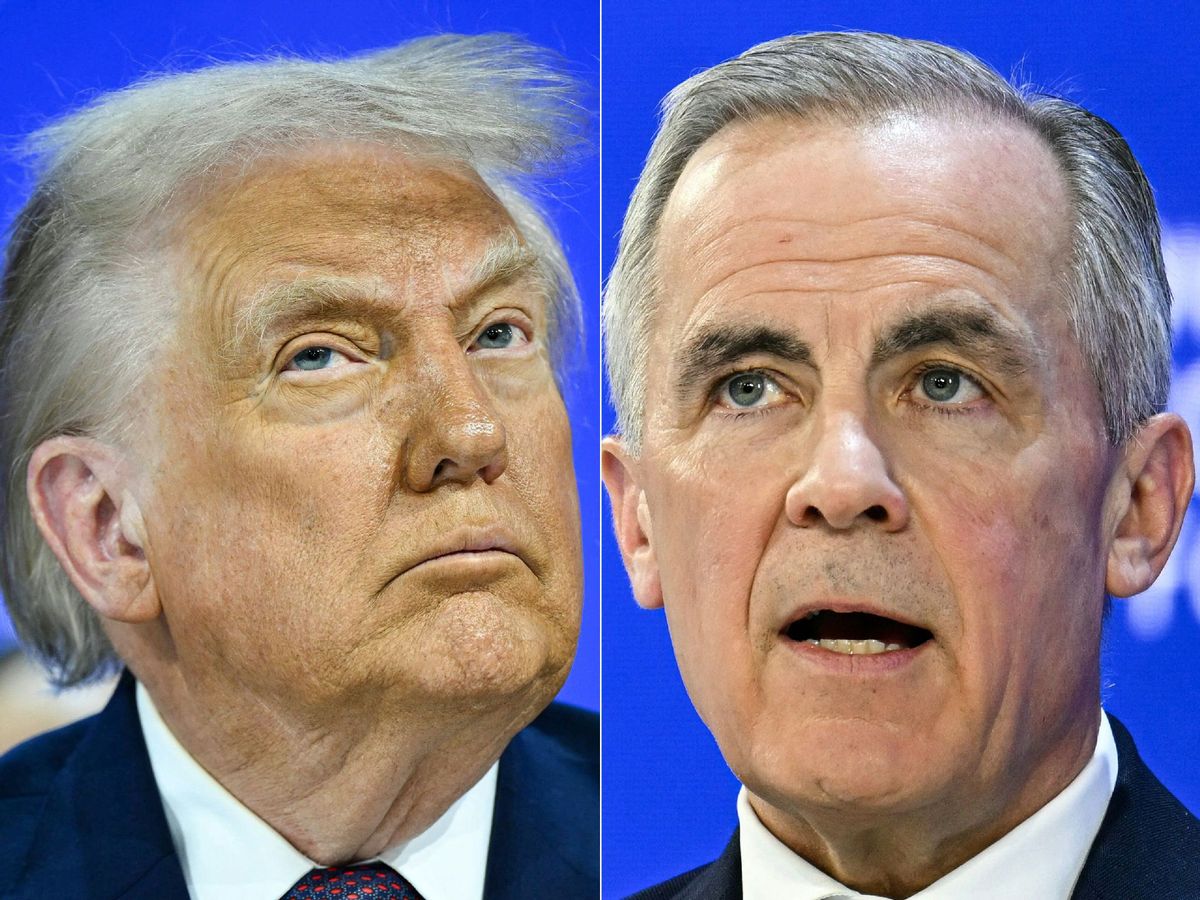
File Photo: This combination of pictures created on Jan 24, 2026 shows US President Donald Trump in Davos on Jan 22, 2026 and Canada’s Prime Minister Mark Carney in Davos on Jan 20, 2026. [Photo/Agencies]
The United States government’s abrupt shift from praising Canada’s trade engagement with China to threatening sweeping tariffs reflects political calculations rather than trade mechanics, experts say.
The US’ shift in tone came just days after the current administration publicly praised Canadian Prime Minister Mark Carney’s negotiations with China, before warning on Saturday that 100 percent punitive tariffs would be imposed on all Canadian goods entering the US if the agreement moved forward.
“(US President Donald) Trump’s contradictory statements … stem from personal pique and strategic coercion,” said Jiang Wenran, founding director of the China Institute at the University of Alberta in Canada.
Jiang pointed to Carney’s speech last week at the World Economic Forum in Davos, Switzerland, as the immediate trigger for the US’ reversal. In that speech, Carney criticized “coercion” and urged middle powers to avoid becoming victims of “American hegemony”, remarks that were met with a standing ovation.
“Trump, whose own speech was poorly received, felt upstaged and responded with insults, calling Carney a ‘governor’ and threatening punitive tariffs,” he said. “This personal dynamic fueled the shift in tone.”
Beyond personal factors, Washington’s tariff threat should be understood as a strategic move, Jiang said.
“Strategically, Trump’s threat is a blunt tool to enforce US dominance in North America,” he said, adding trade talks between China and Canada are viewed in Washington as “a direct challenge to US economic strategy”.
The tariff threat aims to force Canada back into alignment and deter other US allies from pursuing similar independent trade policies, Jiang said.
In response to US pressure, Carney said Canada has no plan to pursue a full free trade agreement with China, and that the current negotiations are designed to remain consistent with existing US-Mexico-Canada Agreement rules, he said. “This positioning is a deliberate effort to avoid triggering the USMCA’s ‘poison pill’ clause while still advancing a pragmatic trade agenda.”
Within Canada, Washington’s tariff threat has intensified an existing domestic debate, Jiang said.
One camp, he said, fears the “catastrophic economic impact” of losing access to the US market, which absorbs about 75 percent of Canada’s exports, and favors accommodation. The other camp sees US pressure as confirmation that Canada must reduce its dependence on the US.
“They advocate resisting the threats and accelerating trade diversification,” he said.
Ottawa’s response so far has been one of restraint paired with quiet resistance, Jiang said.
“Canada has adopted a strategy of calm defiance,” he said, pointing to the government’s emphasis on domestic resilience, including the “Buy Canadian” campaign, and continued efforts to broaden trade ties.
Jiang highlighted Canada’s “cautious calculus” — seeking tangible economic benefits from diversification while minimizing immediate legal and political risks from the US.
Ron Stagg, a history professor at Toronto Metropolitan University, said the US tariff threat appears to be driven more by political signaling than by clear trade mechanics.
“It is not clear whether this reflects a rethinking of possible consequences for the United States, or a reaction based on something one of his advisers said,” Stagg said.
The US administration has framed the threat around the idea that it will not allow Canada to become “a back-door for Chinese imports to the US”, he said.
Under the as-yet unsigned agreement, he noted, Canada would allow 49,000 Chinese electric vehicles into the country at a 6.1 percent tariff, in exchange for China lowering tariffs on certain Canadian agricultural and seafood products. “Since these EVs and any future cars from China, or, in fact, any manufactured goods would not be exempt from American duties when entering from Canada, there seems little threat,” he said.


