The 2026 World Cup kicks off in Mexico City on Thursday, with the biggest football tournament on the planet beset by high ticket prices, geopolitical tensions and conflict in the Middle East.
Nine teams from the Middle East and North Africa will compete in this edition’s expanded, 48-team field. It is the largest representation from the region in the history of the competition.
“It will be interesting to see the extent to which, during press conferences, their statements about the war, that there’s even concerns about people coming from Gulf states who are here,” said Paul Poast, a professor at the University of Chicago.
Perhaps none will draw as much scrutiny as Iran, a country the US, one of three countries co-hosting the World Cup, is at war with.
Iran’s players landed in Mexico on Monday, having been denied a base in the US. Their players wore gold “#168” lapel pins, pointing to the victims killed by a likely American missile strike on an elementary school on February 28.
Visa applications for many of its staff have been denied, and Iran’s ticket allocation for the World Cup has been pulled days before their opening match against New Zealand in Los Angeles on June 15.
“The Iranian hostage crisis is something a lot of people haven’t got over,” said David Kilpatrick, a football historian and professor at Mercy University in New York.
“When the USA faced Iran before, it was a real show of unity and global citizenship: the absurdity of warfare, the futility of it, and that sport can bring reconciliation and friendship. Competition can do that.”
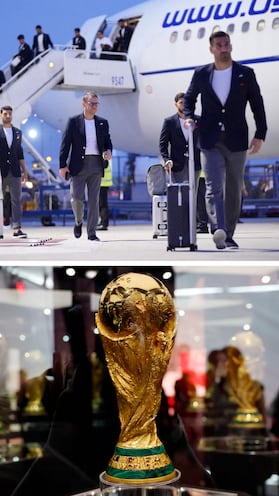
World Cup arrivals face trouble at US border
US President Donald Trump’s immigration policies have impacted staff members, officials and fans of other countries, including one Iraqi team staff member and a Somali referee who were denied entry at US airports in recent days. And of the 39 countries under a full or partial US travel ban, four – Iran, Haiti, Ivory Coast and Senegal – will play at the World Cup.
Trump’s trade row with co-hosts Canada and Mexico have also fallen back into view with the renewal of the USMCA, while Immigration and Customs Enforcement (ICE) agents will be present at fixtures throughout the World Cup.
“There’s all these ways in which current geopolitics is absolutely on centre stage for this World Cup,” Poast said.
For Kilpatrick, who grew up a supporter of the New York Cosmos, the final to be played at the Meadowlands, the New Jersey stadium made famous by legendary Brazilian footballer Pele, carries additional meaning under the current geopolitics.
“For the global game to be played in the metropolitan area where the UN congregates is a really significant moment in history that I hope we can make the most of,” Kilpatrick said.
An expanded field
Forty-eight teams from six confederations will compete in this new, supersized format with three hosts and 16 venues scattered across North America.
For the global game to be played in the metropolitan area where the UN congregates is a really significant moment in history that I hope we can make the most of
David Kilpatrick,
professor and football historian
Thirty-two teams will advance to the knockout rounds – the top two from every group plus the eight best third-place teams.
From the Middle East and North Africa, Jordan, will make their debut. Iraq are making a first appearance at the global finals in four decades, while Qatar will be making only a second appearance after hosting the 2022 tournament.
“I hope Iraq will do very well,” Crescent Petroleum chief executive Majid Jafar said during a think tank event in Washington on Monday. “There’s never been 48 teams before, so I think the whole world is excited.”
Morocco will bring the biggest star power from the region with a squad that includes Real Madrid playmaker Brahim Diaz, Ayyoub Bouaddi from Lille and Paris Saint-Germain’s Achraf Hakimi, who will captain The Atlas Lions.
Al Hilal winger Salem Al Dawsari will be hoping to replicate Saudi Arabia’s 2022 triumph over Argentina, while free agent Mohamed Salah looks to guide Egypt to a first win on the game’s biggest stage.
Defending champions Argentina are expected to be among the favourites to lift the trophy on July 19, while Spain, France, Portugal, Brazil and England are all considered to be fighting for the title as well.
USMNT under pressure
One team not expected to lift the trophy but under immense pressure is the US, who were knocked out in the Round of 16 in 2022.
The side features a young crop of talent with attacking power led by forward Haji Wright and winger Christian Pulisic.
“They’re a talented group but they seem to lack the grit and determination of earlier teams that typified or characterised the men’s national team,” Kilpatrick said.
US team captain Tim Ream said the squad understands the pressure before them. Two of the US’s three games will be played during prime time hours.
“This is a once-in-a-career opportunity. And with that comes, you know, more expectation, more pressure, but at the same time, we have to enjoy it,” he said during a press conference at the US base camp in Irvine, California.
Only two host countries – South Africa in 2010 and Qatar in 2022– have failed to advance past the group stage.
Aiming to capitalise on their status as co-host and young squad, the US Soccer Federation brought in former Tottenham Hotspur and PSG head coach Mauricio Pochettino.
For Pochettino, advancing to the quarter-finals – a feat the US accomplished just twice – would not be a good enough result. Speaking to Men In Blazers, the Argentine coach suggested the US dare dream to lift the trophy.
And after a 2-1 loss to Germany on Saturday, Pochettino told media he believes the US fans can help power the Stars and Stripes this tournament.
“You can feel the fans, how exciting they are, and yes, I don’t need to see the fans because I am already excited, but I think it’s really important for the team, it’s very important for the spirit of the team that the players start to feel that, and that is important,” he said.