
 As the world continues to react to the changing political and technological landscape, jewellers continue to find ways to persevere and meet ever-changing consumer demands. Image generated by AI
If 2026 has taught Canadians anything, it is to expect the unexpected. Unprecedented global events have presented new challenges and opportunities. While long-time alliances are being tested, new ones are being formed. The effects of political uncertainty, reflected in the price of gold, gas, and groceries, leave consumers wondering when relief will arrive. Technological advances continue to push the boundaries, and when implemented thoughtfully, can unlock meaningful benefits for businesses and consumers alike. For the Canadian jewellery industry, this is not the first time we have faced monumental challenges influenced by international affairs—and it certainly won’t be the last. Fortunately, we are a resilient community and continue to evolve and survive in less-than-ideal times.
Political turmoil instigated by U.S. tariffs has strengthened Canada’s focus on supporting Canadians and triggered the expansion of new international opportunities for economic growth. The State of Trade 2026 report notes that “exports to the U.S. dropped 3.7 per cent last year. But this was offset by an 11.1 per cent increase in exports to non-U.S. markets, which now account for 32.8 per cent—almost a third—of total Canadian exports, the highest amount in four decades. Last year was also the first year since 2013 that Foreign Direct Investments into Canada—valued at $93.0 billion—exceeded our Canadian investments abroad.”1
Canada delivers value as a strong and dependable trade partner, now with “15 free trade agreements (FTAs) with 51 countries representing
61 per cent of global GDP.”2 Canada has been working diligently to expand its trade agreement network, attract more foreign direct investment, provide support to Canadian exporters, and build trade infrastructure. Removing trade barriers allows Canadian businesses to “benefit from lower costs, reduced red tape, more customers worldwide and new suppliers and technology.”3
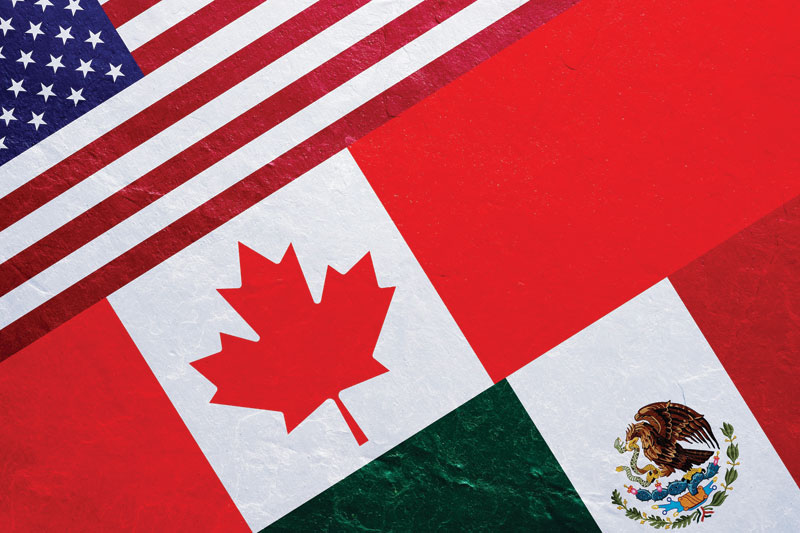 With Canada-U.S. trade already in decline since early 2025, apprehensive Canadians await news on the Canada-United States-Mexico Agreement (CUSMA) negotiations. Photo © Andrewdo/Courtesy Bigstockphoto.com
With Canada-U.S. trade already in decline since early 2025, apprehensive Canadians await news on the Canada-United States-Mexico Agreement (CUSMA) negotiations. At the time of writing in August 2026, “Canada-U.S. trade tensions escalated [over the] weekend after negotiations failed to produce a new agreement before a key deadline, triggering U.S. tariffs of 50 per cent on nearly $30 billion worth of Canadian exports.”4 Impacted products include some jewellery and precious metals, even CUSMA-compliant products. The Doane Grant Thornton report also detailed Prime Minister Mark Carney as saying, “Canada was unwilling to accept terms that would compromise national sovereignty or key industries, while U.S. officials argued Canada declined to finalize the deal. In response, Canada has suspended negotiations, recalled its negotiating team, and announced plans for dollar-for-dollar retaliatory tariffs targeting sectors including steel, dairy, appliances, pulp and paper, and electronics, with measures expected to take effect after Labour Day.” 4
Discretionary spending has been reduced in the average Canadian household due to the elevated cost of everyday essentials. Many Canadians are “[worried] about how trade tensions and tariffs might affect prices and jobs. Bank of Canada surveys found people are delaying major purchases and focusing on essential items because they expect prices to rise.”5
The Canadian Federation of Independent Business (CFIB) notes that “the Iran-U.S. conflict pushed gasoline prices to a three-year high. While prices have eased from their peak, they remain well above pre-crisis levels and will take time to adjust.”6 A June 2026 Leger poll found that “72 per cent of Canadians report a negative impact on their personal finances from higher fuel prices. CFIB estimates fuel costs have increased by about $53 per vehicle per month [ . . . which] translates to roughly $1.3 billion in additional fuel costs every month—money that is no longer available for other household purchases.”6 For businesses, “higher fuel prices are increasing operating costs while also weakening consumer demand.”6 Canadian jewellers are now competing with basic living expenses for consumer dollars; a battle fought before with ingenuity and perseverance.
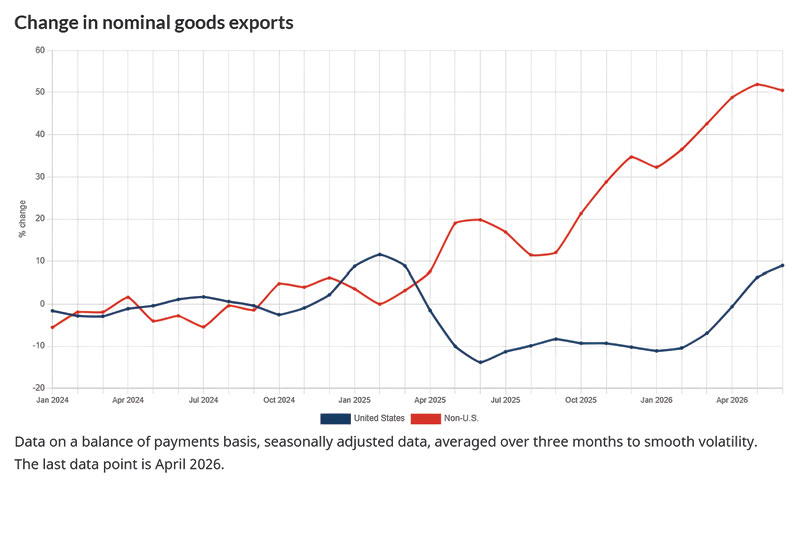 Source: Statistics Canada (Table 12-10-0011-01); Global Affairs Canada Calculations
As often seen in uncertain times, gold remains strong. Retail Insider reports that “gold reached a new record in early 2026, with prices approaching $4,000 per ounce in Canadian dollars, reflecting a sharp rise over the past year and reinforcing its role as a hedge against economic uncertainty.”7 The price increase created significant affordability barriers resulting in a “sharp fall in gold jewellery imports, as customers reduced the frequency of purchases and shifted to lighter-weight pieces.”8 Silver also saw an increase “gaining momentum, supported by both investment demand and industrial usage.”7 Jewellers will need to navigate the new reality of gold jewellery and bullion being not only for “discretionary purchases, but also for stores of value.”7
As technology continues to become more powerful and accessible, businesses must adapt to remain relevant. Retail Insider also reports that “retailers are using virtual consultations and AI-driven tools to improve product discovery, while financing options such as buy now, pay later are helping to increase conversion rates. These developments reinforce the importance of omnichannel strategies that combine digital convenience with the trust and experience of physical retail.”7 Moneris highlights that “retailers who treat 2026 as a turning point, not a hurdle, will shape the next decade of Canadian commerce. The choices made this year about service, technology, pricing, and purpose will determine who earns trust in a market where trust is becoming the most valuable currency.”5
A seamless online and in-store retail experience has never been more important for jewellers. Deloitte reports that “while most shopping journeys begin online, about 80 per cent of purchases still happen in person.”5 A recent survey by KPMG found that “66 per cent of respondents prefer the in-store shopping experience, driven in part by a desire to physically ‘try out’ items before buying them; 26 per cent said they appreciate the speed at which they can get products in-store, and 57 per cent said they preferred in-store shopping because they were frustrated with the online experience.”9 Jewellers who can optimize their online presence and build consumer trust will see the results in-store when the consumer is ready to buy.
 A seamless online and in-store retail experience has never been more important for jewellers. Jewellers who can optimize their online presence and build consumer trust will see the results in-store when the consumer is ready to buy. Image generated by AI
The Buy Canadian movement continues to dictate Canadian buying habits. Retail Insider reports that “consumers haven’t lost interest in shopping small: they’re just being more intentional about it. In fact, consumer preference for shopping at small businesses has nearly tripled compared to last year. People still want to support local businesses, but they need compelling reasons to do so.”10 Brand activations in the form of in-person events have helped to counter digital fatigue. Ellen Bennett, founder of Hedley & Bennett, notes, “although the amount of time people report spending online has increased, [there has been] a shift in focus from online to offline and an increase in the number of events.”11 Retail Insider notes that “businesses that stay visible, build authentic relationships both on and offline, and clearly communicate their value are much more likely to win those customers even in a price-conscious environment.”10
As technology continues to revolutionize our everyday lives, people remain a key component in the customer journey. A study by KPMG found that “90 per cent of respondents said they would return to a store where they’ve received exceptional service from knowledgeable staff.”9 Businesses can and should empower their staff with technology-enabled tools to manage inventory or to gain product knowledge; the key remains creating trust with consumers. Keen sales associates must quickly identify and adjust their sales presentation to suit the needs of their clients. “Retailers should recognize the generational differences in shopping preferences, with younger consumers being more comfortable with online shopping, while older demographics favour [a] traditional retail environment.”9
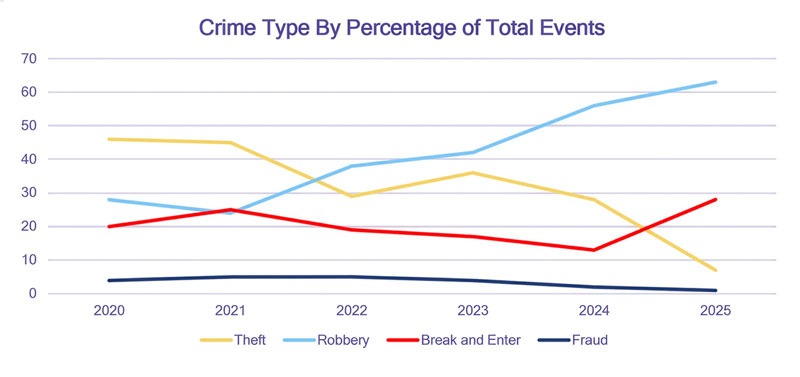 Source: JVC’s 2025 Annual Crime Report
Consumer habits for discovery on the internet have changed from a traditional search to a question posed to AI. In a McKinsey study, “73 per cent of respondents said they used AI to learn more about brands and products, 61 per cent used it to compare products and services, and 57 per cent used it to get personal recommendations.”11 For retailers, AI “offers the power to unlock efficiencies and forge deeper customer connections. Those retailers who seize AI’s full potential are likely to be those who blend technological ingenuity with human intuition, with the aim of creating a future where businesses can be both smarter and more resilient,” says Duleep Rodrigo, head of Consumer & Retail, KPMG.13
Social media has become the “front door” for discovery while playing an essential role in establishing trust with a business. Business owners across Canada are finding themselves becoming “creators.” Content plays an important role “to bring in customers, to drive sales and to keep the customers coming back who already love them.”10 This year has seen a shift in social media with an emphasis on brands being approachable and unpretentious. “2026 is the year of the normal person,” says Grace Clarke, a marketing and brand strategy expert, and Shopify’s former head of community marketing. “Brands are finding more ways to engage with real people in a genuine way. It’s about finding ways to encourage your community to talk about the products, sort of optimizing for the group chat and not the public Instagram story.”11 Jewellery content creators can stand out by “thinking less like advertisers and more like publishers. Show your personality, educate your audience, share customer stories, and create content consistently. People want to see authentic stories, products in action, behind-the-scenes content, and recommendations they can trust.”10
Engagement isn’t limited to post likes and shares; the comment section is becoming an integral part of the marketing strategy. Clarke notes that “right now, consumers, more than ever, are participating in marketing. You see this in people commenting on advertisements.”11A Brightlocal survey found that “89 per cent of customers are more likely to want to make a purchase because they feel considered and heard,”11 highlighting the importance of responding to messages, whether they are positive or negative. “It’s essential to moderate and manage customer comments and develop a new rhythm for content generation that is readable by agent-based search engines. [Generative Engine Optimization] GEO is a key battleground for winning back customers.”14
 Businesses that can successfully integrate the latest technology while providing the personalized approach jewellers are known for will come out on top in these uncertain times. Image generated by AI
For the busy business owner, AI technology has come to the rescue. “AI can also help streamline content creation, making it easier for even the smallest teams to maintain a strong presence.”10 The benefits don’t stop at content creation; AI can be used for merchandising, customer experience, and productivity. The value for retailers is enhanced customer experience with personalized marketing. “Instead of random product suggestions, retailers can utilize gen AI to analyze customer preferences and shopping behaviors to anticipate customer product restock needs and make more accurate product suggestions.”15
To be successful, retailers must find their purpose, build AI readiness throughout the company, launch pilot projects with measurable return on investment (ROI), and prioritize responsible AI and compliance.”15 Isabelle Allen, global head of Consumer, Retail and Leisure, states that retailers must “rethink how they design customer journeys, manage inventory, set prices, and engage consumers. AI in retail is both the great leveler and the ultimate differentiator: it promises to democratize access to innovation yet rewards those bold enough to reinvent their business from the ground up.”12 For jewellers, our superpower is not fulfilling need, it’s creating desire and turning desire into need, something AI has yet to learn how to do.16
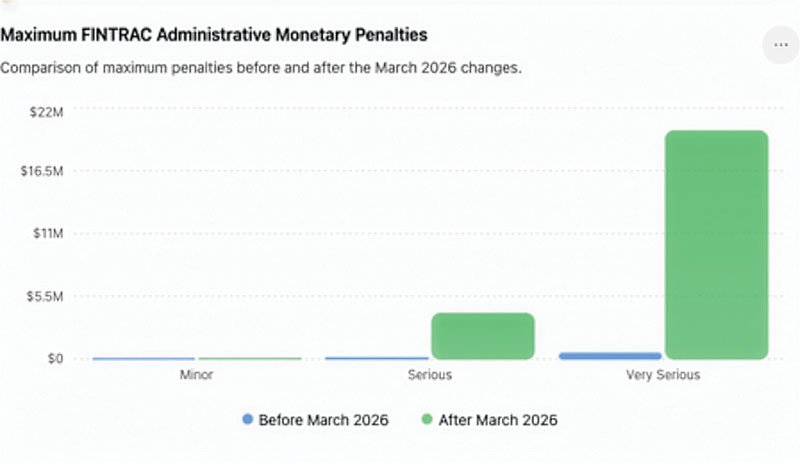 Source: Outlier Compliance Canada
Crime continues to impact the Canadian jewellery industry. According to Jewellers Vigilance Canada’s (JVC’s) 2025 Annual Crime Report, “the total number of jewellery crimes recorded increased from 201 in 2024 to 233 in 2025, a 16 per cent increase. Total dollar losses increased by 62 per cent to $44,076,000 in 2025, up from $27,131,000 in 2024. Sustained high gold values and an escalating pattern of high-value robbery events are significant contributing factors.”17
The JVC report highlights observations made between 2020 and 2025, noting that:
- Robbery as a percentage of total events and total dollar losses continues to increase, reaching its highest level in the five-year dataset.
- Break-and-enters increased significantly in 2025, reversing a multi-year flat trend and representing a growing concern for the industry.
- Thefts declined sharply in 2025 in both volume and total loss value, though average loss per event increased, indicating fewer but higher-value incidents.
- Fraud remains low in reported volume but continues to be under-reported, particularly cyber-related fraud events.
- Ontario, and specifically the Greater Toronto Area, remained the dominant location for robbery events in 2025.
- Firearms continue to be used or displayed in a significant number of incidents, and 2025 saw multiple events where shots were fired, resulting in injury.
- Smash-and-grab robberies remain the most prevalent type, typically involving organized groups targeting retail locations.
2026 has also seen its fair share of updates from FINTRAC regarding Anti-Money Laundering (AML) compliance for jewellers. The compliance experts at Outlier explain FINTRAC’s “higher expectations for compliance programs, which must be reasonably designed, risk-based, and effective, leaving more room for Canada’s AML regulator FINTRAC Review to assess deficiencies.” 18 FINTRAC has expanded oversight, examination, and enforcement powers. Its most recent annual report indicates that assessment instruments like the Supervisory Risk Assessment Questionnaire (SRAQ) are more common than examinations. Jewellers need to understand and respond to these types of requests from FINTRAC, as a failure to do so may result in penalties. As of March 2026, “there are significantly higher administrative monetary penalties (AMPs) for non-compliance (the maximum penalties are now 40 times previous levels, with a cap of the higher of $30 million or three per cent of global revenue). Fortunately, FINTRAC is also required to assess reporting entities’ ability to pay as part of their penalty calculations.”18 In addition to ongoing updates to existing compliance programs, jewellers will need to prepare for universal enrollment, which will be required for all reporting entities. The final format is not yet known, but the Canadian Jewellers Association (CJA) will continue to monitor requirements and engage with policymakers on behalf of jewellers.
As the world continues to react to the changing political and technological landscape, jewellers continue to find ways to persevere and meet ever-changing consumer demands. The need for seamless integration between online and in-store experience means jewellers must take advantage of technology that connects consumer data, inventory, and marketing into one streamlined ecosystem. AI presents new opportunities for personalization and product discovery for consumers while allowing jewellers to optimize their workflows. Businesses that can successfully integrate the latest technology while providing the personalized approach jewellers are known for will come out on top in these uncertain times.
Notes
1 Read more: https://international.canada.ca/en/global-affairs/corporate/reports/chief-economist/state-trade/2026
2 Learn more about the free trade agreements: https://www.tradecommissioner.gc.ca/en/market-industry-info/free-trade-agreements.html
3 Check out the government’s data: https://international.canada.ca/en/global-affairs/campaigns/diversifying-trade
4 Discover more: https://www.doanegrantthornton.ca/insights/how-new-tariffs-could-affect-canadian-businesses/
5 Read the Moneris trends report: https://www.moneris.com/en/blog/posts/growth-strategy/2026-retail-trends-in-canada?srsltid=AfmBOorSM_EjpQiLfBpV-fN_oMvcCTQXnaAlAGj3jd8aOwHNj4c0eJsC
6 See CFIB’s research: https://www.cfib-fcei.ca/en/research-economic-analysis/fuel-prices-are-hitting-small-businesses-where-it-hurts-costs-and-demand
7 Read Retail Insider’s report: https://retail-insider.com/reports/2026/05/q1-2026-jewelry-watches-report-expansion-meets-shifting-consumer-investment/
8 Learn about trends in gold: https://www.gold.org/goldhub/research/gold-demand-trends/gold-demand-trends-q1-2026/jewellery
9 See KPMG’s insights: https://kpmg.com/ca/en/insights/2025/04/connected-commerce-a-seamless-omnichannel-experience.html
10 Read Retail Insider’s report: https://retail-insider.com/retail-insider/2026/07/small-businesses-embrace-the-role-of-creator-to-get-seen-in-2026/
11 See Shopify’s blog: https://www.shopify.com/blog/ecommerce-trends-predictions
12 Get more KPMG insights: https://assets.kpmg.com/content/dam/kpmgsites/xx/pdf/2026/06/ai-in-retail-report.pdf.coredownload.inline.pdf
13 See more: https://kpmg.com/xx/en/our-insights/transformation/ai-in-retail-lessons-from-strategy-to-storefront.html
14 Learn more: https://us.fashionnetwork.com/news/In-the-luxury-sector-customers-have-already-embraced-ai-for-their-searches-brands-must-adapt,1848657.html
15 Read more about the potential in Gen-AI: https://kpmg.com/ca/en/insights/2025/09/unlock-gen-ai-potential-in-retail.html
16 Discover Forbes’ article on AI: https://www.forbes.com/sites/pamdanziger/2026/07/16/why-ai-cant-crack-the-code-of-luxury-desire/
17 See the Jewellers Vigilance Canada 2025 Annual Crime Report
18 See Outlier Compliance Canada
Alanna Campbell is an independent appraiser and the membership co-ordinator of the Canadian Jewellers Association.
