
3alexd/Getty Images
Consumers in North America have had their eyes on Chinese electric vehicles for a while now. After all, Chinese EVs are much cheaper than American ones. They’re also becoming insanely convenient; China’s new sodium-ion EV battery can fully charge in just 11 minutes. However, Chinese vehicles are effectively banned in the United States due to a series of policies that outlaw the nation’s software and hardware, as well as prohibitively high tariffs on the actual vehicles. North of the border, though, is a different story because China is sending its EVs to Canada.
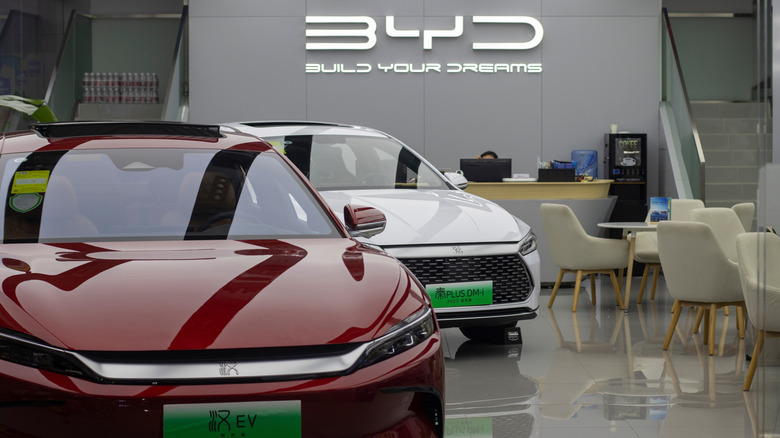
The deal with China is slated to bring up to 49,000 EVs into Canada in 2026 at a reduced tariff rate. In fact, 2,910 Chinese EVs already arrived in May 2026. Records from Transport Canada indicate that BYD — the Chinese company on track to becoming the most popular electric vehicle brand in the world — is already cleared as a vehicle importer in Canada as well. Does this mean that you’ll start to see Chinese EVs in the U.S.?
The Trump administration has not made any indication of pursuing a similar tariff deal with China in regard to EV imports, but you might see Canadian drivers crossing the border in their foreign-made vehicles — for a while, at least. It is currently legal to cross the border in a Chinese EV, but Congress introduced legislation in June that aims “to prohibit the entry into the United States of connected vehicles associated with foreign adversaries.”
Why is Canada importing Chinese EVs now?
Tada Images/Shutterstock
The tariff-quota deal between Canada and China comes at a great time for the Chinese side, as its EV companies have moved beyond just building cars out of necessity for expanding business. But Canada benefits greatly from the deal, too. The Chinese government agreed to drop import duties on Canadian canola crops, which is one of Canada’s most valuable agricultural exports. Some Canadian auto dealers see the deal as a promising opportunity to invest in new market avenues. While there’s some apprehension around data security and service support, the ability to deal in desirable foreign vehicles could stimulate local economies and prop up new businesses.
The arrival of Chinese EVs is most exciting for consumers because component shortages raised EV prices in 2026, so many drivers are seeking ways to embrace electric at an affordable entry point. In an interview with BNN Bloomberg, Daniel Breton, president and CEO of Electric Mobility Canada, indicated that the price for some of the imported Chinese EVs may be below $35,000 CAD (below $25,000 USD). Compared to the cheap EVs that are actually worth buying in the United States, that’s a value proposition that many Canadians can’t ignore.
